01Case Study
Facets UX Style Guide
Design Systems · UX Governance · Accessibility · Performance Support
A shared UX design system providing reusable standards, components, patterns, and accessibility guidance for Facets product teams.
Demonstrates
UX/HCI · Instructional Design · Accessibility · Product Leadership
I design human-centered experiences that help people understand information, learn effectively, make better decisions, and perform complex work.
My work brings together UX/HCI, instructional design, accessibility, multimedia, and product leadership to turn complex needs into clear, usable, and meaningful experiences.
About
I work at the intersection of user experience, instructional design, technology, and organizational leadership. My background spans UX/HCI, learning experience design, accessibility, product design, multimedia, and performance support.
Across these areas, the common thread is human-centered design: understanding what people need to accomplish and creating experiences that help them do it more clearly, effectively, and confidently.
My professional experience in UX and product design has shaped how I approach instructional design. Both disciplines require understanding people, reducing unnecessary complexity, organizing information meaningfully, and evaluating whether a designed experience helps someone accomplish a goal.
Instructional design has expanded that perspective by placing greater emphasis on learning objectives, practice, feedback, assessment, accessibility, and transfer to performance.
Together, these perspectives allow me to consider not only whether an experience is usable, but also whether it helps people understand, learn, decide, and perform.
My work is supported by experience in UX/UI and product design, along with graduate study across four disciplines. This multidisciplinary foundation helps me move between user needs, learning needs, business requirements, technology constraints, and cross-functional collaboration while maintaining a human-centered perspective.
People + Problem + Context + Evidence
Clarify the audience, problem, context, constraints, and available evidence before deciding what to build.
Learning + Experience + Interaction
Translate findings into an appropriate solution: a learning experience, interface, performance-support resource, multimedia artifact, or a combination.
Usability + Accessibility + Requirements + Evidence
Evaluate the work against user and learner needs, requirements, and accessibility considerations, and identify assumptions and gaps.
Feedback + Learning + Iteration
Use findings and feedback to improve the solution while keeping a clear connection between the original need and the resulting design decisions.
Understand the people and the problem. Design with purpose. Validate with evidence. Refine with intention.
Professional Work
These projects demonstrate how I apply UX/HCI, instructional design, accessibility, multimedia, and performance support to complex workplace needs, from reusable design guidance and software training to structured professional learning experiences.
Design Systems · UX Governance · Accessibility · Performance Support
A shared UX design system providing reusable standards, components, patterns, and accessibility guidance for Facets product teams.
Demonstrates
Multimedia Learning · Software Training · Performance Support
A task-focused learning experience designed to make complex Facets workflows easier to learn through short video tutorials, supporting resources, and realistic product interactions.
Demonstrates
Learning Experience Design · UX Education · Applied Practice
A six-week professional learning experience that introduces User-Centered Design principles and methods to professionals who work with UX teams, combining instruction with applied activities in research, design thinking, heuristic evaluation, usability testing, and prototyping.
Demonstrates
Software Training · Multimedia Instruction · Guided Practice
A structured learning resource designed to introduce Camtasia through guided software instruction and task-focused learning activities.
Demonstrates
My professional projects demonstrate applied design practice. My instructional-design coursework provides another space to investigate accessibility, responsible AI, project leadership, evaluation, and emerging learning technologies.
ID Coursework
My graduate instructional-design work provides a space to apply learning theory and design principles to contemporary challenges involving accessibility, responsible AI, project management, inclusive design, and immersive learning. The selected projects below show how I analyze instructional problems, evaluate alternatives, communicate recommendations, and design learning experiences for different contexts.
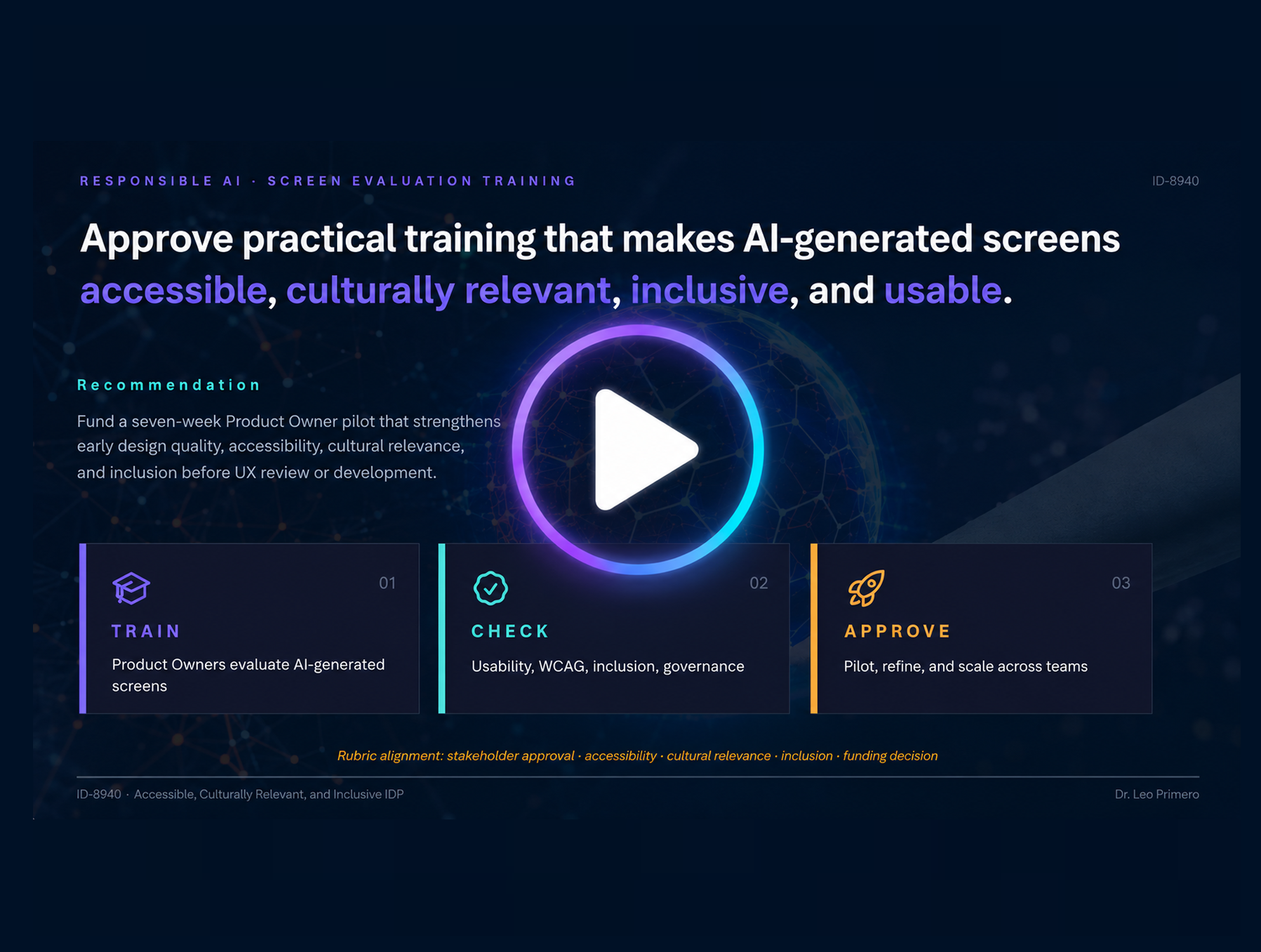
ID-8940 · Accessible Design in Instructional Design
Responsible AI · Accessibility · UX Evaluation · Governance
A stakeholder presentation proposing a structured pilot for evaluating AI-generated screen designs before UX review, connecting responsible AI practices with usability, accessibility, design quality, and human oversight.
What I learnedTranslating an instructional and design challenge into a clear stakeholder proposal connecting user needs, organizational risk, and responsible AI practices.
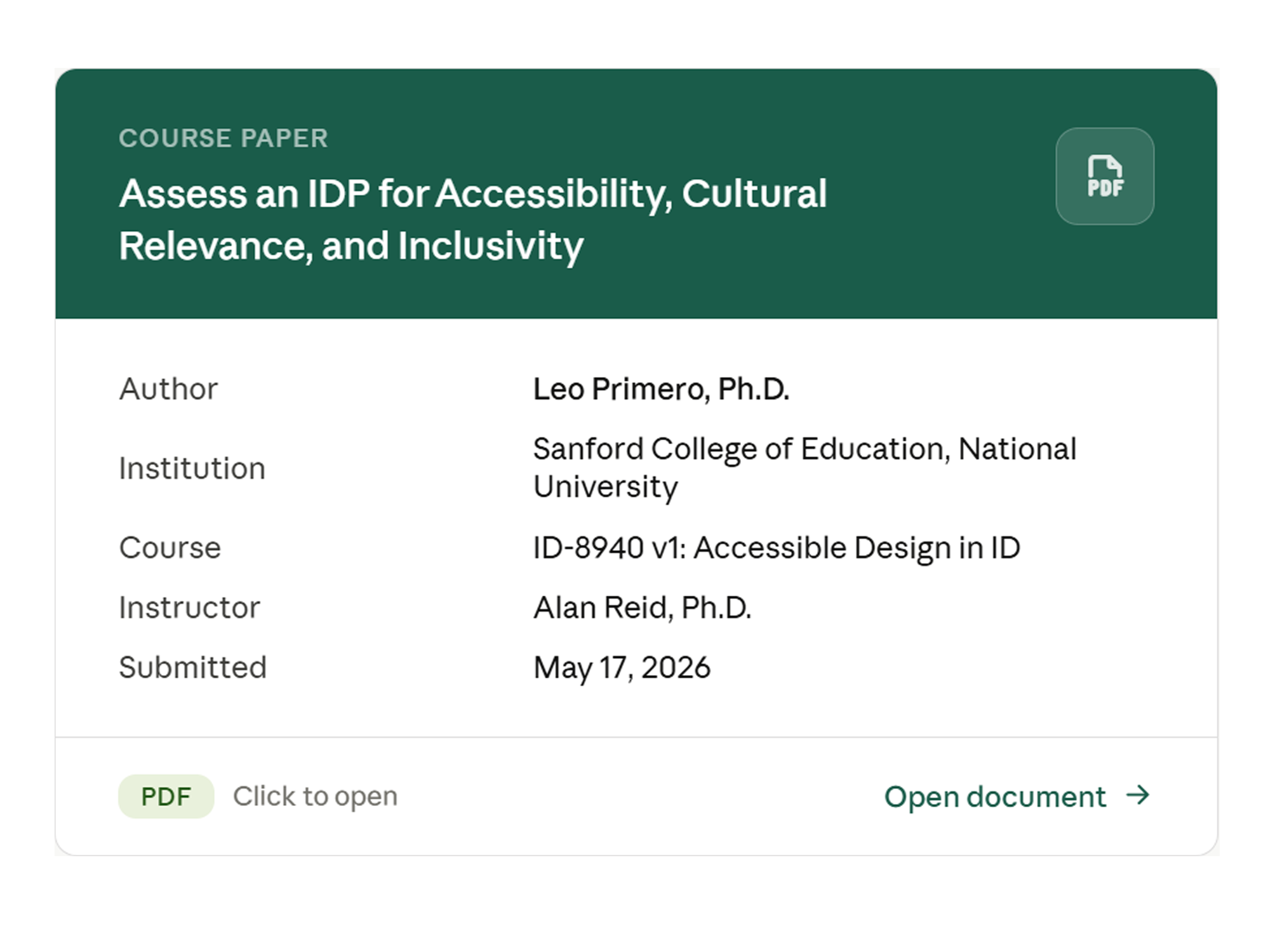
ID-8940 · Accessible Design in Instructional Design
Accessibility · Inclusive Design · UDL · Evaluation
An evaluation of a workplace Retail POS training plan for accessibility, cultural relevance, and inclusive design using WCAG 2.2, Universal Design for Learning, and Quality Matters to identify strengths, gaps, and practical improvements.
What I learnedAccessibility and inclusion are interconnected instructional-design responsibilities rather than separate compliance activities.
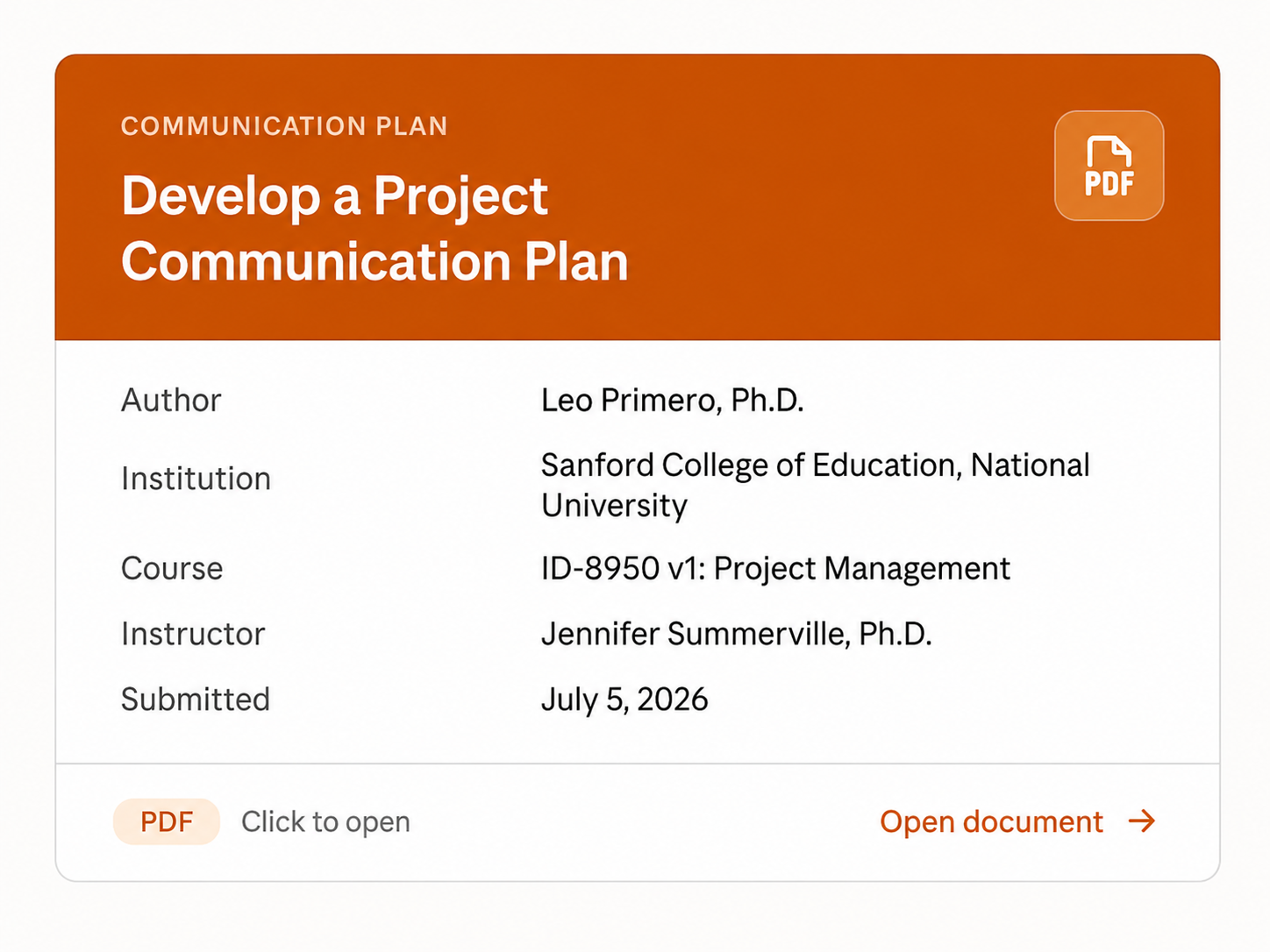
ID-8950 · Project Management for Instructional Design
Project Management · Stakeholder Communication · Responsible AI
A stakeholder communication plan for a proposed Figma AI Workshop Series for UX and Product Teams, defining communication needs, frequency, ownership, delivery methods, decision points, and feedback mechanisms.
What I learnedCommunication is a project-management tool for alignment, accountability, informed decision-making, and timely feedback.
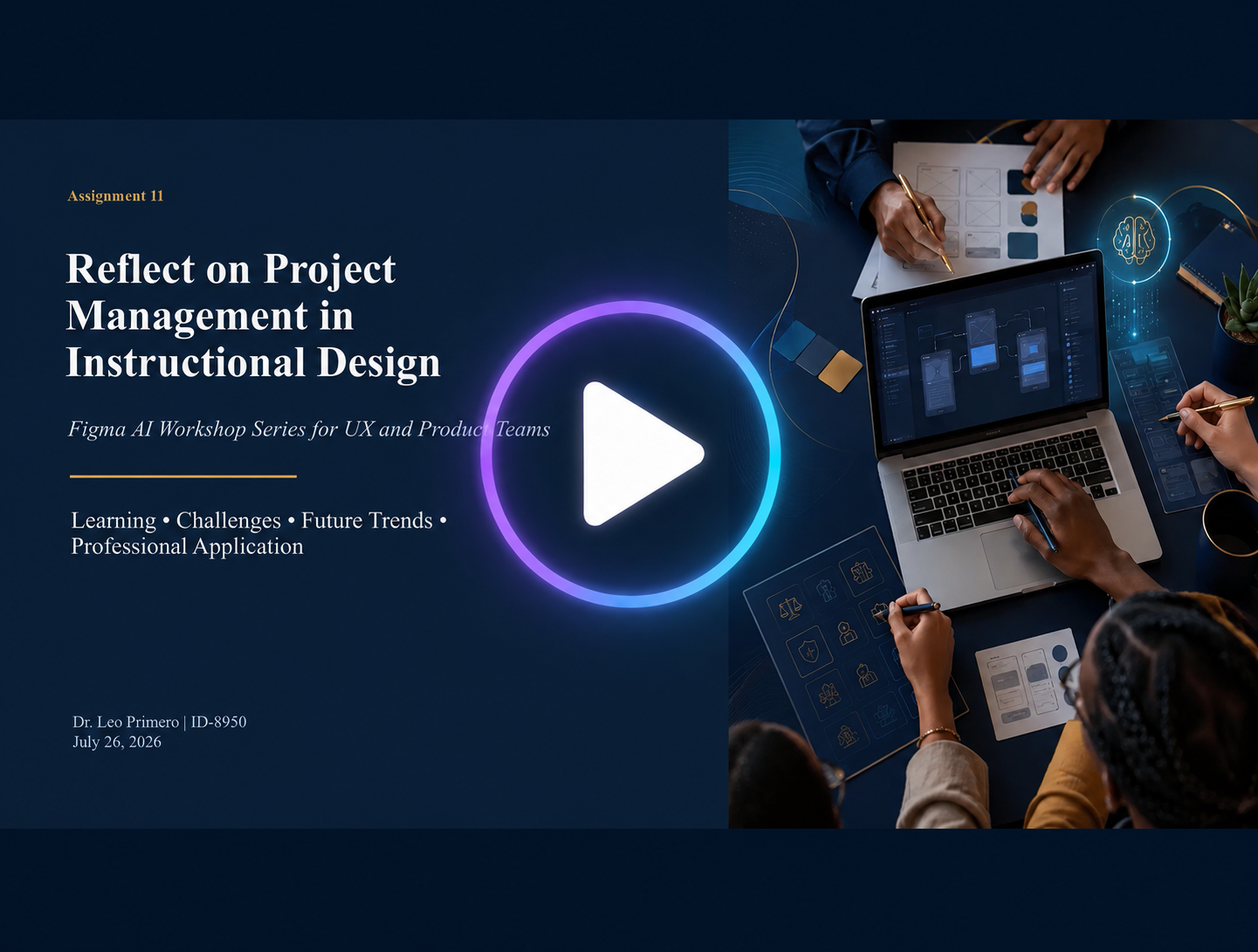
ID-8950 · Project Management for Instructional Design
Reflective Practice · Project Leadership · Risk · Responsible AI
A narrated reflection examining how planning, risk management, quality, stakeholder communication, responsible AI, and project closure shape instructional-design projects.
What I learnedProject management is a leadership practice connecting people, priorities, decisions, risks, and learning outcomes.

ID-8930 · Interactive Media Design
Immersive Learning · Scenario-Based Learning · Decision-Making
A 10-frame Instructional Design Decision Lab that places learners in the role of an instructional designer solving a realistic workplace training challenge. Learners investigate project information and stakeholder needs, compare ADDIE, Dick and Carey, Kemp, and Agile Learning Design, justify a decision, receive instructional feedback, and compare their choice with alternative approaches.
Learner path
What I learnedImmersive, scenario-based environments can support evidence analysis, decision-making, feedback, and reflection rather than simply presenting content.
These projects represent more than individual course assignments. Together, they show an evolving instructional-design practice grounded in human-centered design, accessibility, evidence, responsible technology, reflection, and application.
Capabilities
My work draws from instructional design, UX/HCI, accessibility, multimedia, project leadership, and emerging technology. I use these capabilities together to understand complex problems and create experiences that support learning, decision-making, and performance.
I design learning experiences around clear needs, meaningful objectives, applied practice, feedback, and performance.
Demonstrated through
I use human-centered methods to understand users, workflows, context, and constraints before defining a solution. My UX background also informs navigation, information hierarchy, interaction, usability, and cognitive demands.
Demonstrated through
I treat accessibility and inclusion as design responsibilities that begin during planning rather than checks performed only after development.
Demonstrated through
I use multimedia and task-focused resources when they help people understand procedures, perform work, or access information at the point of need. The medium follows the problem rather than the other way around.
Demonstrated through
I approach project management as the coordination of people, evidence, priorities, risks, communication, and decisions, not simply schedules and deliverables.
Demonstrated through
I explore AI and emerging technologies as tools that can expand design possibilities while still requiring appropriate human judgment, validation, accessibility, and governance.
AI Assists. Humans Decide.
Demonstrated through
Design around people, their goals, and their context.
Reduce barriers and account for learner and user variability from the beginning, not as an addition at the end.
Distinguish what is known, what needs validation, and what remains an assumption.
Choose methods and technologies because they fit the problem, not because they are available.
Keep human judgment, validation, and accountability central when using AI and emerging technologies.
Design for what people ultimately need to understand, decide, learn, or do.
Each capability above links to the projects that demonstrate it.
Contact
I welcome opportunities to connect with professionals working across UX/HCI, instructional design, accessibility, product design, learning technology, and responsible AI.
If you would like to discuss my work, exchange ideas, or explore opportunities to collaborate, please feel free to reach out.
I believe effective design begins with understanding people and ends with evidence that the experience supports what they need to understand, learn, decide, or do.